Hidden in Plain Sight: The Women Who Quietly Built Hollywood's Golden Age
Hidden in Plain Sight: The Women Who Quietly Built Hollywood's Golden Age
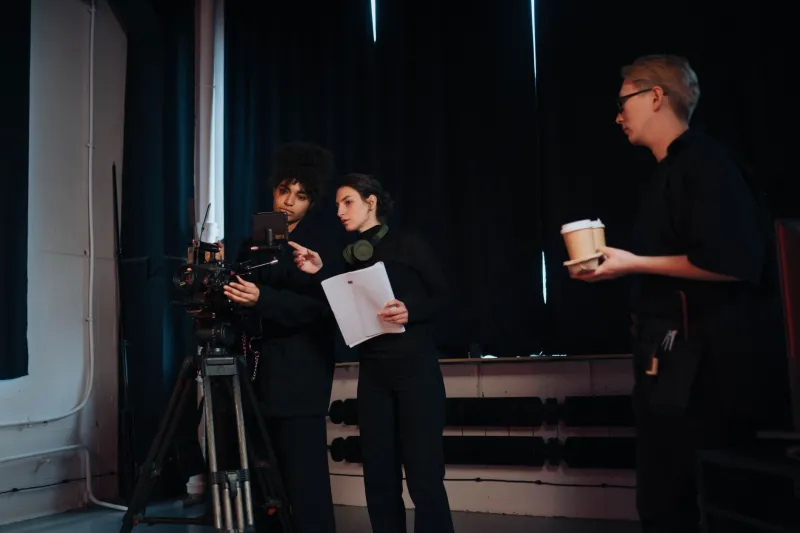
There's a photograph that keeps circulating in old Hollywood retrospectives. A celebrated director stands at the center, megaphone in hand, surrounded by crew members and studio executives. Off to one side — almost cropped out of the frame entirely — a woman watches with quiet intensity. She holds a notebook. Her eyes are fixed not on the camera, but on the set. Most captions don't mention her name.
For decades, that cropped figure has been the defining image of women in Golden Age Hollywood: present but unnamed, essential but invisible. Now, thanks to a slow accumulation of recovered diaries, private correspondence, and candid interviews with descendants, a different picture is starting to emerge — one where those unnamed women weren't just witnesses to cinematic history, but active architects of it.
The Notebook Nobody Talked About
Film historians have long known that the wives and partners of major directors often played informal roles behind the scenes. What they're only beginning to understand is how substantive those roles actually were.
Take the case of Alma Reville, Alfred Hitchcock's wife, who stands as perhaps the most documented example of this dynamic. Hitchcock himself credited her with catching a critical continuity error in Psycho — a mistake that, had it gone unnoticed, would have shattered the film's most iconic scene. But Reville was far more than a proofreader. She co-wrote screenplays, shaped story structure, and by multiple accounts served as Hitchcock's most trusted creative voice for decades. Her official credits? Scattered and inconsistent, buried under pseudonyms or omitted entirely.
Reville is the exception primarily because people did eventually talk about her. For every Alma Reville, there are dozens of women whose contributions were never recorded at all — whose influence lived only in the margins of shooting scripts, in handwritten notes passed across dinner tables, in arguments that reshaped entire third acts and were never attributed to anyone.
Letters from the Margins
Researchers at several university film archives have spent recent years combing through collections that were donated by Hollywood estates and largely left untouched. What they've found is striking.
In one collection connected to a prominent 1940s studio director, a trove of letters reveals his wife routinely receiving early drafts of scripts and returning them with detailed notes — not gentle suggestions, but specific, line-level edits with clear reasoning attached. In several cases, the language she proposed appears almost verbatim in the finished films. Her name appears nowhere in the credits.
In another archive, a director's personal diary references his partner's role in restructuring the second act of what became one of his most acclaimed pictures. He writes about her instincts with something close to reverence. She is described as seeing things he simply couldn't. And yet the official record — the studio press releases, the retrospective essays, the AFI tributes — makes no mention of her at all.
These aren't isolated cases. They're a pattern.
Why the Erasure Was So Total
Understanding why these contributions disappeared requires understanding the industrial logic of classical Hollywood. Studios operated on the star system — and the director was a star. The mythology of the singular creative genius, the auteur before the term even existed in American discourse, was commercially valuable. It was easier to sell a film as the vision of one brilliant man than to explain the collaborative, often domestic reality behind it.
Women were also working against a culture that actively discouraged them from claiming professional authority. Many of the spouses and partners interviewed by descendants in recent oral history projects described a kind of internalized self-erasure — a genuine belief that their job was to support, not to be seen supporting. Several explicitly said they never thought of themselves as contributors in any formal sense, even as they were shaping the films that would define American cinema.
There's also a more uncomfortable possibility: that some directors understood perfectly well how much they owed their partners, and chose not to share the credit anyway. The diary entries and letters don't always paint flattering portraits of the men involved.
The Daughters Remember
Some of the most vivid testimony has come from the children of these couples — now elderly themselves — who grew up watching their mothers work in ways the outside world never saw.
One woman, the daughter of a director whose films are still taught in every serious film school in the country, describes her mother reading scripts aloud at the kitchen table every night, stopping to question motivations, challenge dialogue, and push back on endings she found emotionally dishonest. "She had a phrase," the daughter recalls. "She'd say, that's not how people actually feel. And he'd go back and change it."
Another descendant, a grandson, found boxes of annotated screenplays in his grandmother's handwriting after she passed. The notes are sophisticated — structurally aware, emotionally precise, occasionally blunt. He's been quietly trying to get a film archive to accept them for years. So far, the interest has been polite but limited.
What the Record Owes Them
The question of how to retroactively acknowledge these contributions is genuinely thorny. Film history is already written. Credits are fixed. The men these women supported are, in most cases, long dead and celebrated beyond revision.
But there's a growing argument among film scholars that the conversation itself matters — that naming these women, even now, even in footnotes and academic papers and articles like this one, does something important. It corrects the record. It makes the actual process of filmmaking visible. And it offers a more honest account of how creative work actually happens, which is almost never the product of a single isolated genius working in a vacuum.
Cinema has always been a collaborative art. The Golden Age was built on collaboration that extended far beyond the studio lot — into living rooms and bedrooms and late-night conversations over cold coffee. The women who held those conversations deserve to be part of the story.
They were never really in the shadows. We just stopped looking for them.
A Story Still Being Written
Archive work is slow. Family memory is imperfect. And the film industry has not historically been eager to complicate its own mythology. But the researchers doing this work believe there's much more to find — more letters, more annotated drafts, more diaries sitting in attics waiting for someone to ask the right questions.
For now, the project of recovering these women's contributions is largely happening outside mainstream film culture. It lives in academic journals, in small retrospectives, in conversations between descendants who recognize something familiar in each other's stories.
But that's changing. Slowly, the frame is widening. And the women who were almost cropped out entirely are finally coming into focus.