Lost in the Margins: The Invisible Art of Translating Cinema for American Eyes
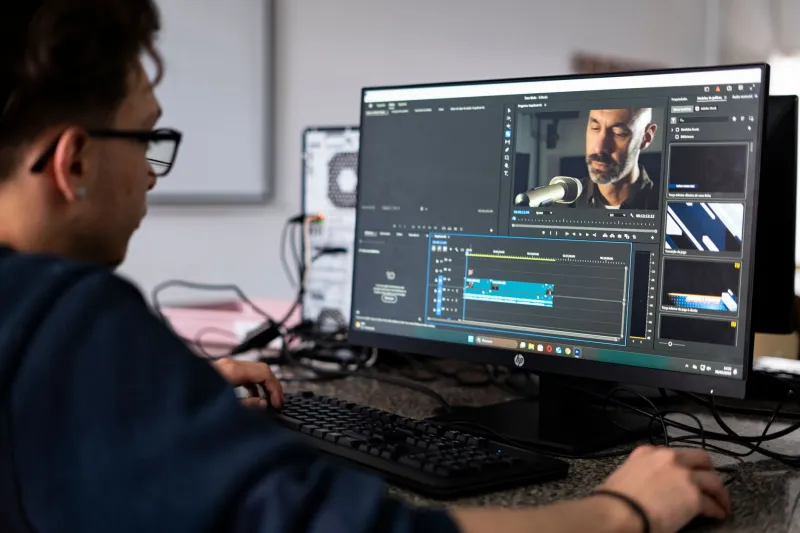
The subtitle flashes for maybe two seconds. You read it, absorb it, and move on. What you almost certainly don't think about is that someone spent twenty minutes agonizing over that exact word choice—weighing rhythm, register, cultural resonance, and the hard constraint of how many characters fit on a screen before a line becomes unreadable.
Subtitle writing is one of cinema's great invisible crafts. When it's done well, you don't notice it at all. When it's done poorly, the seams show in ways that can undermine an entire film's emotional impact. And when it's done brilliantly—when a translator finds the precise English equivalent of an untranslatable feeling—something genuinely extraordinary happens: a film made in Seoul or Paris or Mexico City lands on an American audience with its full emotional weight intact.
That's a harder trick than it sounds.
The Two-Second Rule and Its Consequences
Professional subtitle writers work within a set of technical constraints that most viewers never think about. Lines typically can't exceed a certain character count. They have to sync with the rhythm of spoken dialogue. They need to leave enough white space on screen that they don't fight with the image for attention. And they have to be readable in the time a viewer's eye naturally takes to scan a line of text.
All of that would be challenging enough if translation were simply a matter of finding equivalent words. But language doesn't work like that, and neither does cinema.
"You're not translating words," explains one localization specialist who's worked on dozens of international titles for American distribution. "You're translating a performance. The subtitle has to carry the same emotional information as the actor's delivery, which means you're making creative choices about tone and register that have nothing to do with literal accuracy."
A formal sentence in Korean might be warm and intimate in context. A blunt line in Italian might be gentle in its original emotional register. Getting that right requires the translator to understand not just the language but the cultural codes embedded in how people speak to each other—and then find English equivalents that carry the same charge without feeling like a translation at all.
When a Single Word Changes Everything
The stakes of these choices become clearest when you look at cases where translation decisions significantly shifted how films were received.
Consider the challenges around films that deal with concepts that simply don't have English equivalents—the Japanese notion of mono no aware, the Portuguese saudade, the Korean han. These aren't just vocabulary gaps. They're entire emotional architectures that a film might be built around. How a subtitle writer navigates those gaps can determine whether an American audience feels the emotional core of a film or experiences it as vaguely foreign and difficult to connect with.
There are also the cases where overly literal translations produce unintentional comedy, draining scenes of their weight. Or where translators make the opposite error—reaching for American idioms that feel anachronistic or tonally wrong against the visual world of the film. A period drama set in 1940s Paris probably shouldn't have characters saying anything that sounds like contemporary American casual speech, even if that's technically what the French dialogue is doing in its own register.
The Parasite phenomenon is instructive here. Bong Joon-ho's film became a genuine cultural event in the US, and part of that success had to do with how well its subtitles preserved the film's tonal complexity—the dark comedy, the class critique, the moments of genuine horror. The translation work made the film feel specific and Korean while remaining emotionally accessible to audiences who'd never seen anything quite like it.
The Localization Debate
Within the field, there's an ongoing and genuinely interesting argument about how far localization should go. On one side are translators who believe their job is to minimize the foreignness of a film for American audiences—to find the most natural, idiomatic English equivalent for every line, even if that means departing significantly from what was literally said. The goal is fluency, the feeling that you're not reading a translation at all.
On the other side are those who argue that a certain amount of productive friction is part of the experience of watching international cinema. That smoothing everything over robs American audiences of the encounter with genuine difference—which is, arguably, the whole point of watching films from other cultures.
"There's a version of localization that's basically erasure," says one subtitle writer who works primarily on arthouse and festival titles. "You end up with something that reads like an American film. Which is fine if that's what you want. But then what was the point of watching the original?"
Most working translators operate somewhere between these poles, making judgment calls on a line-by-line basis that depend on the specific film, its intended audience, and the distribution context.
The Streaming Effect
The explosion of international content on American streaming platforms has created a strange new pressure on subtitle writers. Demand has skyrocketed—the success of shows and films from South Korea, Spain, and elsewhere has made international content a genuine priority for major platforms rather than a niche offering. That's good news for the craft in terms of visibility.
But it's also created a volume problem. The sheer quantity of content being subtitled has led to compressed timelines, lower rates in some corners of the market, and—critically—the increasing use of automated translation tools that generate rough subtitles for human editors to clean up rather than having experienced translators work from scratch.
The results are sometimes fine. They're sometimes noticeably rough in ways that undermine the viewing experience. And they've sparked a real conversation within the localization community about what's being lost when the craft gets treated as a commodity.
The Credit They Deserve
Like so many of the craftspeople who make cinema possible, subtitle writers and localization experts are almost never acknowledged in the films they help bring to life. They don't appear at premieres. They're not quoted in reviews. The work is visible only in failure.
But every time an American audience falls in love with a foreign film—every time a story from another country genuinely moves someone who's never been anywhere near its setting—a translator made that possible. They built the bridge. They found the words.
That's not a technical service. That's an art form.