Grain and Grit: Why Young Filmmakers Are Choosing the Hard Way and Shooting on Celluloid
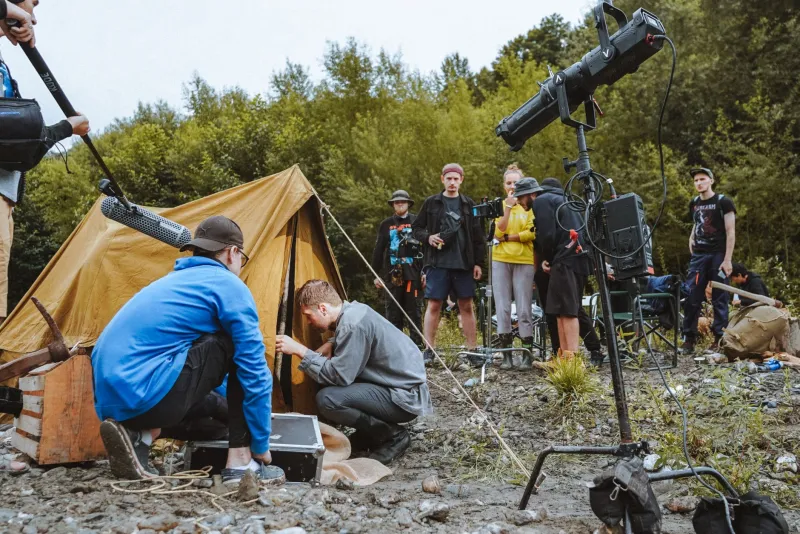
Maya Torres shot her first short on her phone when she was seventeen. Her second on a borrowed DSLR. Her third — a twenty-minute drama she made at twenty-three with a borrowed budget and a borrowed crew — she shot on 16mm film. It cost twice as much, took three times as long to see the results, and she says it was the best decision she's ever made as a filmmaker.
"There's something that happens when you load a magazine," she explains. "You become aware that every frame costs something. That changes how you work. It changes how everyone on set works."
Torres is part of a counterintuitive trend that's been building quietly for several years now. Across America, a new generation of independent filmmakers — people who came of age entirely in the digital era, who have no personal memory of a world before instant playback and unlimited storage — are deliberately choosing celluloid. Not out of nostalgia for something they never experienced. Out of something more complicated and more interesting than that.
The Digital Paradox
Here's the strange thing about the democratization of filmmaking: it made everything easier and, for some people, less meaningful.
When the barrier to entry collapsed — when anyone with a few hundred dollars could shoot technically competent footage — the act of shooting lost some of its gravity. You could roll on everything and sort it out later. Coverage became infinite. The edit became the real creative battlefield, not the set.
For a certain kind of filmmaker, that felt wrong. Not wrong in a judgmental way, but wrong in the way that a too-easy path sometimes feels wrong — like you're bypassing something important.
Film stock reintroduces consequence. When you're paying for every roll, when you can't immediately check what you got, when mistakes can't be undone with a software update, you have to decide things. You have to commit. That commitment, it turns out, is something a lot of young directors are actively hungry for.
The Aesthetic Argument
There's also the simple, undeniable fact of how film looks.
This is where conversations about celluloid often begin — and too often end. Yes, film grain has a texture that digital noise doesn't replicate, despite decades of software attempting to fake it. Yes, the way celluloid renders light, particularly in highlights and shadows, has a quality that cinematographers spend considerable energy trying to approximate digitally. These are real differences, not just audiophile-style mythology.
But younger filmmakers who shoot on film tend to be impatient with the purely aesthetic conversation. They acknowledge the look matters, but they don't want that to be the whole story.
"If I just wanted the look, I'd use a filter," says one recent film school graduate who shot his thesis project on Super 8. "That's not why I do it. I do it because the process changes what I make."
That process argument keeps coming up. The medium isn't just a delivery mechanism for a pre-formed vision — it actively shapes the vision. Celluloid has a particular rhythm to it, a pace that tends to slow things down on set, encourage longer takes, make directors think more carefully about blocking and composition before the camera rolls. The resulting films often have a different quality of attention, a stillness that's hard to manufacture in post.
The Economics of Choosing Difficulty
None of this is cheap. Film stock prices have risen significantly as the market for it has contracted, and processing and scanning add more costs on top. For an emerging filmmaker without industry backing, choosing celluloid is a genuine financial sacrifice.
This is where community comes in. Across the country, networks of film-shooting independent directors have formed informal collectives — sharing equipment, pooling orders for stock to get better pricing, trading knowledge about which labs still process which formats. In cities like Los Angeles, New York, Chicago, and Austin, these communities have become a real support structure for analog filmmaking.
Lab infrastructure has also stabilized somewhat after years of contraction. A handful of dedicated labs have held on and, in some cases, expanded their services in response to renewed demand. Kodak has continued producing 16mm and 35mm stocks, in part because of this younger market. The ecosystem is fragile, but it's alive.
What Shooting Film Teaches
Ask working cinematographers and directors who've made the switch — or who shoot both formats depending on the project — what celluloid actually teaches, and certain themes emerge consistently.
Patience. You can't rush a film set the same way you can rush a digital one. The medium demands a certain deliberateness.
Collaboration. Because everyone on set knows the stakes are higher — that there's no safety net of unlimited takes and instant review — crews tend to communicate more carefully. Problems get solved before the camera rolls rather than in the edit.
Commitment. Every choice is a real choice. You can't hedge. You can't shoot it both ways and figure it out later. That constraint, paradoxically, often produces more decisive and distinctive work.
These aren't small things. For a filmmaker developing their voice, they might be exactly the right lessons at exactly the right time.
Not a Rejection of Digital — A Conversation With It
It's worth being clear about what this movement isn't. It's not a wholesale rejection of digital filmmaking, which remains a remarkable and genuinely expressive tool. Most of the filmmakers drawn to celluloid also work digitally — they understand both worlds and are making deliberate choices about which serves a given project.
What they're rejecting is the assumption that digital is always the answer. That convenience is always a virtue. That more options always produce better work.
In choosing the harder, more expensive, more unforgiving path, they're making an argument about what filmmaking is for. It's not just content production. It's not just coverage acquisition. It's a set of decisions made under real conditions, with real stakes, in real time. The grain in the image is evidence of that. It's proof that something actually happened.
For a generation that grew up in a world of infinite digital storage and instant erasure, that kind of proof matters more than you might expect.