Handmade Light: The Rebels Cooking Up Film Stock in Garages and Keeping Celluloid Alive
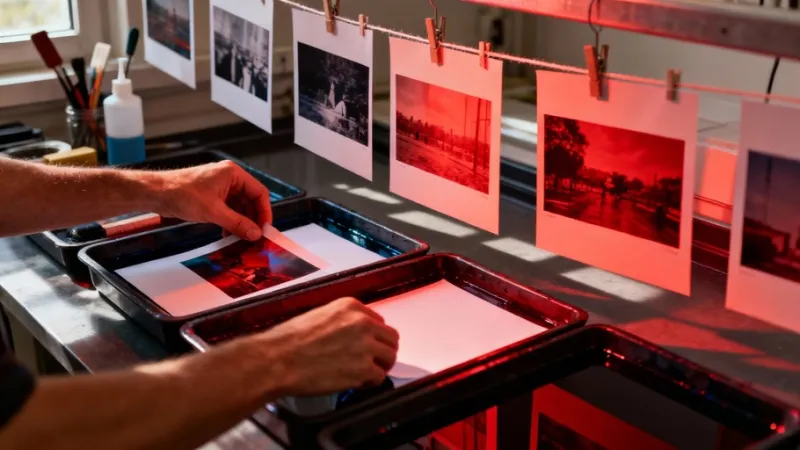
Photo: film emulsion darkroom chemical process analog photography lab, via images.stockcake.com
Somewhere in a converted garage outside Portland, a woman named Tess is stirring silver halide crystals into a gelatin solution and thinking about light. The mixture has to be exactly right — temperature, timing, chemical ratios — or the emulsion won't coat evenly, won't respond to exposure the way she needs it to, won't produce the images she's spent years learning how to chase. She's been at this for six hours. She'll probably be at it for six more.
Tess makes film stock. Not for a studio, not for a manufacturer, not for any commercial purpose that would make conventional business sense. She makes it because she believes it matters, because she thinks something essential about cinema lives inside the chemical process, and because the alternative — letting analog emulsion disappear entirely from independent hands — is something she refuses to accept.
"People act like this is a hobby," she says, not looking up from the coating tray. "It's not a hobby. It's a survival strategy."
The Collapse That Created a Movement
To understand why people are making film stock in garages, you need to understand how completely the industrial infrastructure for analog photography and cinema collapsed over the past two decades. Kodak, once the dominant force in global film emulsion, filed for bankruptcy in 2012. Fujifilm discontinued most of its cinema stocks. Agfa, Ilford, and other manufacturers pulled back dramatically. The professional film supply chain, which had supported everything from Hollywood productions to independent filmmakers to photojournalists, contracted to a fraction of its former size.
What remained was expensive, limited in variety, and increasingly hard to source in smaller quantities. For independent filmmakers working outside institutional budgets, shooting on film went from difficult to nearly impossible.
But a funny thing happened. Instead of giving up, a subset of filmmakers, chemists, and artists started asking a different question: what if we make it ourselves?
The Manufacturers Who Refused to Quit
A few small-scale operations have emerged as anchors of the analog revival. Film Ferrania in Italy — resurrected by a group of former employees of the original Ferrania factory — has been producing limited runs of color reversal film that have developed cult followings among cinematographers and still photographers. Wittner Cinetec in Germany continues to supply 8mm and 16mm stocks. In the US, CineStill Film has built a viable business converting Kodak cinema stock for still photography use, creating a crossover market that keeps demand legible.
These aren't garage operations. They're small companies doing serious manufacturing work, navigating the genuinely difficult chemistry of emulsion production while trying to stay economically viable in a market that mainstream industry long ago abandoned.
"The scale we're working at would have been considered a rounding error by Kodak at its peak," says one small-batch producer who has been coating experimental emulsions for independent filmmakers for the past five years. "But it's enough. It's enough to keep the craft alive and to keep people making things."
DIY Emulsion: The Deep End
And then there are people like Tess, working at an even more radical margin. DIY emulsion-making — coating your own film stock from raw chemical components — has a long history in experimental photography and cinema, but it's experiencing a genuine resurgence among a new generation of filmmakers who came to analog through aesthetics and stayed for the philosophy.
The process is demanding and unforgiving. Silver nitrate, the core light-sensitive compound in photographic emulsions, requires careful handling. The gelatin coating process is sensitive to humidity, temperature, and contamination. Early batches are almost always failures — uneven coating, incorrect sensitivity, unpredictable development behavior. Learning to make usable emulsion takes months of experimentation and a tolerance for waste.
But the results, when they work, are unlike anything produced by commercial stock. Handmade emulsions tend toward grain structures that are organic and irregular, sensitivity curves that respond to light in ways that feel less mechanical, and a visual texture that carries the literal fingerprints of the person who made it.
"There's an image I made last year on stock I coated myself that I still think about," says Jordan, a filmmaker based in Chicago who has been making his own emulsions since 2019. "It's a portrait. The grain is enormous and the tones are kind of wrong by any conventional standard. But it looks like a memory. It looks like something that happened inside someone's head rather than in front of a camera. I couldn't have made that image any other way."
Why Directors Are Paying Attention
The DIY emulsion movement might seem like the concern of a tiny, intensely committed subculture — and in terms of raw numbers, it is. But its influence is starting to ripple outward in ways that are hard to ignore.
Several working directors with real commercial credits have started incorporating handmade or small-batch analog processes into their work, not as a gimmick but as a deliberate creative choice. The reasoning tends to be consistent: digital capture has become so technically perfect that it requires significant post-production work to introduce any kind of organic imperfection. Analog, especially handmade analog, starts imperfect. The texture is already there. The process is already doing something.
"I shot a short on homemade stock last year and the DP cried when she saw the dailies," one director told us. "Not because they were beautiful in a conventional way. Because they felt real. Like the film was alive."
That aliveness — the sense that the image is a physical object that was touched and altered by light rather than a data file that was processed — is increasingly what draws filmmakers back to analog processes, even when those processes are harder, more expensive, and less predictable.
The Infrastructure Problem
The DIY emulsion movement faces real structural challenges that enthusiasm alone can't solve. Processing handmade stock requires either access to well-maintained darkroom facilities or the ability to process at home using chemistry that's increasingly difficult to source. Scanning handmade emulsion for editing or projection requires equipment that most post-production houses aren't set up to handle. The whole workflow sits outside the mainstream infrastructure, which means building parallel systems from scratch.
Community labs have become crucial. Spaces like the Mono No Aware collective in New York and various film co-ops across the country offer shared equipment, chemical purchasing pools, and — perhaps most importantly — communities of practice where knowledge gets passed between generations of analog practitioners.
"The knowledge is the most fragile thing," says Tess. "The chemistry is documented. You can learn it. But knowing how to read an emulsion, knowing when it's right, knowing what went wrong when it isn't — that lives in people. If those people stop doing it, it's gone."
A Survival Strategy That Looks Like Art
What drives someone to spend six hours stirring silver crystals in a garage in Portland? It's not economics. It's not convenience. It's something closer to a conviction that cinema has a physical dimension — that the relationship between light and chemistry and celluloid is not merely historical but essential, that something gets lost when images exist only as data.
Whether that conviction is correct is a question that every filmmaker working in this space answers for themselves through the work. But the work is happening. In garages and community labs and converted basements, people are keeping a light-sensitive craft alive through sheer stubbornness and love.
That's not nostalgia. That's something more interesting — a refusal to let the past go without a fight, made frame by handmade frame.