Coffee, Vinyl Stools, and the Truth: Why the American Diner Is Cinema's Greatest Stage
Coffee, Vinyl Stools, and the Truth: Why the American Diner Is Cinema's Greatest Stage
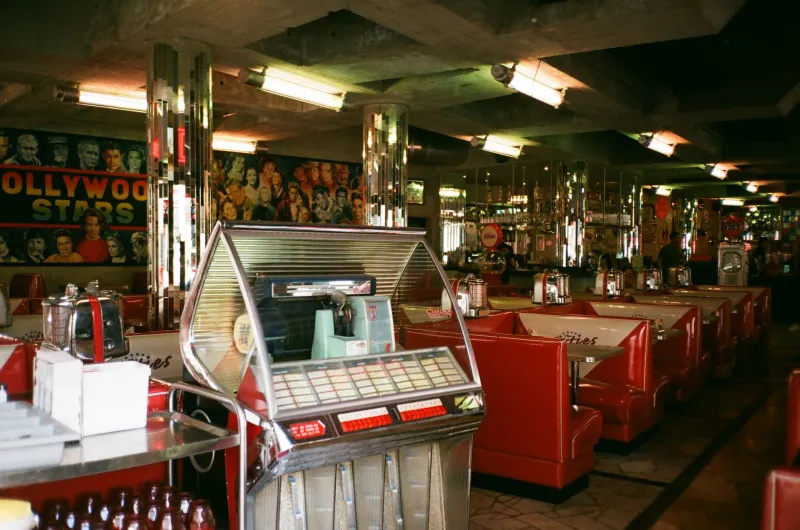
There's something almost surgical about the way a diner strips a character down. No office furniture to hide behind. No living room couch to sink into. Just a laminate countertop, a cup of bad coffee, and the unblinking fluorescent light overhead. Hollywood has known this for decades. And yet every time a director parks a camera inside one of these places, it still feels like a revelation.
The diner isn't just a setting. It's a confession booth with a jukebox.
Hopper's Shadow Over Every Booth
Before there was film, there was Edward Hopper. His 1942 painting Nighthawks — four figures hunched inside a late-night diner, the city dark and empty beyond the glass — essentially handed cinema a visual grammar it's been borrowing ever since. The painting doesn't explain anything. It just shows. And that restraint, that refusal to editorialize, is exactly what makes it so haunting.
Filmmakers absorbed that lesson early. The diner became a place where the camera could do the same thing Hopper did with paint: observe without judging, let the silence say what dialogue can't. You see it in the nervous geometry of Five Easy Pieces (1970), where Jack Nicholson's Bobby Dupea wages a small, furious war against a waitress over a chicken salad sandwich. The scene isn't really about the sandwich. It's about a man who feels the whole world is conspiring to humiliate him — and the diner is the arena where that feeling finally boils over.
The Counter as Class Divider
One reason the diner works so well as a dramatic space is its complicated relationship with class in America. These places were never quite high-end, never quite low-end. They were the in-between, which made them genuinely democratic — or at least they pretended to be.
That tension is exactly what filmmakers exploit. When a character from a comfortable background slides onto a stool next to someone who's clearly struggling, the diner doesn't let either of them pretend. The menu is the same. The lighting is the same. Whatever social armor they've built up outside those glass doors starts to peel.
Think about the opening of Pulp Fiction (1994). Pumpkin and Honey Bunny sit in a diner — a totally ordinary diner — and have what sounds like an ordinary conversation. Then it turns. The mundane setting doesn't soften what happens; it amplifies it. Tarantino understood that violence and menace land harder when they erupt somewhere people expect safety. A diner is where you go to feel normal. Blow that up, and you've got the audience rattled in a way a dark alley never could.
Loneliness at the Counter
If there's one emotion the diner set captures better than any other, it's loneliness. Not the dramatic, operatic kind — the quiet, Tuesday-afternoon kind that most people recognize from their own lives.
Diner (1982), Barry Levinson's semi-autobiographical Baltimore film, practically runs on this feeling. A group of men in their early twenties keep returning to the same booth, ostensibly to hang out, but really because they don't know what else to do with themselves. The diner is the last place where their old social structure still makes sense. Outside, adulthood is waiting, and it's terrifying.
More recently, films like Wendy and Lucy (2008) have used the diner as a marker of economic precarity. Michelle Williams's Wendy eats what she can afford, nurses a coffee for as long as the staff will let her, and the booth becomes a temporary shelter — a few square feet of warmth in a story about having almost nothing. Director Kelly Reichardt doesn't oversell any of it. She just lets the space do its work.
The Geometry of Confrontation
There's also something about the physical layout of a diner that filmmakers find irresistible for confrontation. The counter forces people to sit side by side, which means they can't face each other directly — a blocking challenge that produces some fascinating cinematic results. The booth, on the other hand, traps people across from each other with nowhere to go. Both configurations create a kind of enforced intimacy that a living room or an office can't quite replicate.
Directors have leaned into this hard. In Heat (1995), Michael Mann's legendary coffee shop scene between Al Pacino and Robert De Niro works partly because of its setting. Two men on opposite sides of the law, sitting in a perfectly ordinary restaurant, talking like old friends. The normalcy of the environment makes the subtext — I will kill you if I have to — almost unbearable. Strip away the diner, set that scene in a parking garage or a warehouse, and you lose half its power.
Why It Still Works in the Streaming Age
You might expect the diner to feel like a relic by now. Blockbuster filmmaking has pushed toward the spectacular — cities crumbling, universes colliding, CGI skies filled with warring factions. And yet the diner keeps showing up. In prestige drama. In indie film. In the kinds of quiet, character-driven stories that streaming platforms have given new life.
Part of that staying power is cultural. The American diner is one of the few spaces that almost everyone in this country has a personal memory of — a first date, a late-night drive, a family road trip stop. It carries collective weight before a single frame is shot.
But part of it is purely cinematic. The diner offers filmmakers a closed system: limited exits, forced proximity, artificial light, and the background hum of an ordinary world carrying on regardless of whatever drama is unfolding in booth four. That combination is almost impossible to beat as a dramatic container.
The Stage That Doesn't Move
What's remarkable is how little the diner has changed on screen, even as everything around it has shifted. The counter stools are still there. The coffee is still mediocre. The light still buzzes. And characters are still sitting down in those booths and saying things they probably shouldn't — confessing, arguing, breaking up, making plans, telling lies.
In an industry that sometimes seems allergic to stillness, the diner scene insists on it. It says: sit down, shut up, and let us see who you actually are.
Cinema has never found a better room for that kind of honesty. And honestly, it probably never will.