Still Standing: The Ghost Sets That Haunt America's Desert and Studio Backlots
Still Standing: The Ghost Sets That Haunt America's Desert and Studio Backlots
There's something almost cinematic about the irony. The sets built to create illusions of life — saloons full of imaginary whiskey drinkers, frontier towns no real pioneer ever walked through — end up becoming the most honest things a film production leaves behind. Strip away the cameras, the crew, the actors hitting their marks, and what's left is raw. Exposed. Real in a way the movies themselves never were.
Across the United States, dozens of abandoned film sets are quietly decaying in deserts, on studio perimeters, and in state parks that absorbed them decades ago. Some are famous. Most are not. All of them tell a story that the finished films never quite got around to.
The Mojave's Permanent Extras
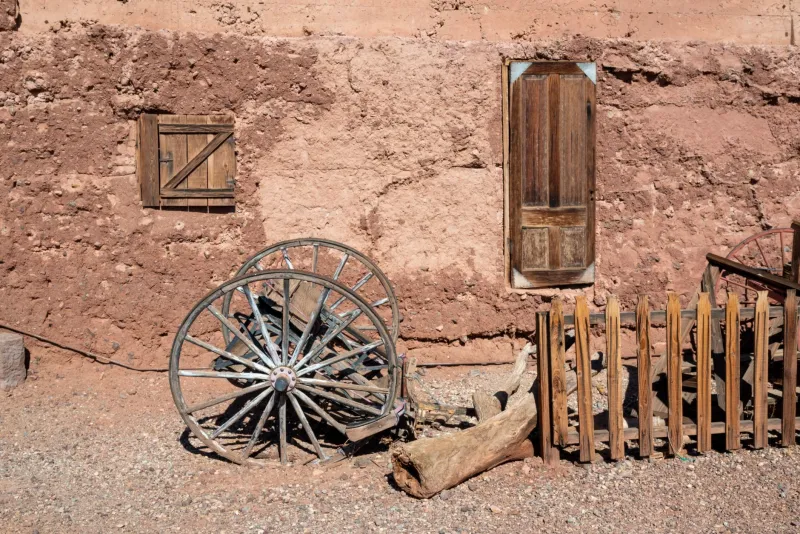
Drive far enough out into the Mojave Desert and you'll find them — wooden storefronts bleached silver by the sun, false-fronted buildings with nothing behind them, hitching posts planted in cracked earth. The western genre practically colonized the American desert, and when the genre faded from box-office dominance in the 1970s, a lot of its infrastructure just... stayed.
Corriganville Movie Ranch in Simi Valley, California, is one of the more well-documented examples. Roy Corrigan built it in the 1930s and leased it to studios for decades — it doubled for everywhere from the Old West to jungle adventures. After a fire in 1970 and subsequent land transfers, portions of the original structures lingered long past their usefulness. Today the site operates as a regional park, and if you hike the trails on a quiet Tuesday, you can still find foundation stones and rock formations that camera operators once framed deliberately.
That deliberateness is what makes these places strange to stand in. Every angle was once considered. Someone decided this particular shadow, this specific sightline, was worth capturing. Now the only audience is the occasional hiker who doesn't quite know what they're looking at.
What the Economics Left Behind
Understanding why sets get abandoned requires a quick look at how Hollywood has always thought about physical production. For most of the studio system's golden era, building was cheaper than location scouting in any meaningful way. Massive backlots — Universal's, MGM's, Warner Bros.' — were essentially permanent sets that got redressed and reused for decades. They were assets on a balance sheet.
The calculus shifted. Television ate into studio profits. Real-estate values around Los Angeles exploded. Tearing down a backlot and selling the land to a developer became far more attractive than maintaining a New York City street facade that nobody was renting anymore. MGM's legendary backlot was sold off in the early 1970s and became a housing development. Most of what made classic Hollywood look like classic Hollywood is gone.
But the remote sets — the ones built far from valuable land, deep in desert or forest — didn't have the same pressure applied to them. Demolition costs money too. If nobody's buying the land and nobody's suing over liability, sometimes the easiest move is to just leave it. Which is how you end up with a fake sheriff's office slowly returning to the earth somewhere in the California high desert.
The Preservation Argument
Here's where things get genuinely complicated. Preservation advocates — and there are organized groups pushing on this — argue that these sites represent a tangible, three-dimensional archive of American film history. You can watch a print of a 1950s western at a repertory cinema and appreciate the craft. But standing on the actual ground where it was filmed, touching the same wood that appeared in the frame, is a categorically different kind of connection.
The counterargument is practical: who pays for it? Stabilizing weathered structures, managing public access, maintaining insurance — these aren't cheap propositions. State parks have absorbed some sets by default, but active preservation requires funding that's hard to justify when there are more pressing cultural heritage priorities competing for the same dollars.
Some sites have found creative middle ground. Paramount Ranch in the Santa Monica Mountains — used for everything from Dr. Quinn, Medicine Woman to HBO's Westworld — was maintained by the National Park Service as part of the Santa Monica Mountains National Recreation Area. A 2018 wildfire destroyed most of the standing structures, which felt, to a lot of people who cared about these things, like losing something irreplaceable. There's now active discussion about what reconstruction or commemoration might look like. The conversation itself is a kind of preservation.
Reading the Ruins
What do these places actually tell us, beyond the obvious nostalgia?
A lot, it turns out, about how films conceptualized the spaces they depicted. Western sets, almost universally, are built at a slightly exaggerated scale — storefronts a little taller than they needed to be, streets a little wider. This was intentional, designed to read correctly on camera with the compression of period lenses. Standing inside these spaces feels subtly wrong in a way that's hard to articulate until you realize you're inside a built argument about how reality should look on film.
That's film craft made physical. It's architecture in service of cinematography, and it's genuinely interesting to architectural historians and film scholars alike — two communities that don't always find obvious common ground.
The crumbling sets also reveal something about which stories American cinema decided were worth telling in the first place. The sheer volume of western infrastructure left across the Southwest is a data point about how thoroughly that genre dominated mid-century production. The abandoned sets are a kind of archaeological record of Hollywood's obsessions.
A Different Kind of Afterlife
There's a reason filmmakers keep returning to these spaces even after they've been abandoned. The locations carry a gravitational pull. Directors have shot new projects in the ruins of old ones, letting the decay itself become part of the visual language. There's something honest about that — cinema acknowledging its own history, its own physical weight.
EveDonus Film has always believed that movies live beyond their runtime, that stories breathe in unexpected places. An abandoned set is maybe the purest version of that idea. The story is over. The production has wrapped. But something remains, standing in the desert heat or the coastal fog, still holding its shape against the sky.
For now, at least. The question of whether we decide these places matter enough to keep — that's a story still being written.