Miles and Manuscripts: How the Open Road Became Hollywood's Best Writing Room
Miles and Manuscripts: How the Open Road Became Hollywood's Best Writing Room
There's a particular kind of thinking that only happens when you're moving.
Not the focused, disciplined kind you do at a desk with a cup of coffee and a deadline. Something looser. Something that slips past the usual mental gatekeepers and lands somewhere surprising. Writers have known about this for centuries. But in American cinema, the connection between physical movement and narrative breakthrough runs especially deep — woven into the DNA of some of the most iconic scripts ever produced.
The road didn't just inspire these films. In many cases, it wrote them.
The Country as a First Draft
When Dennis Hopper and Peter Fonda were developing what would become Easy Rider (1969), the film's philosophy wasn't assembled in a Hollywood office. It emerged from a genuine engagement with American geography, counterculture friction, and the particular loneliness of moving through a country that felt like it was cracking open. The road wasn't just the setting. It was the argument.
That's the thing about American cinema and the open road — they've always had a symbiotic relationship that goes beyond aesthetics. The US is a country built around movement, around the mythology of starting over somewhere new. When screenwriters hit the highway, they're not just changing their scenery. They're tapping into something deeply embedded in the national imagination.
Ridley Scott has talked about how Thelma & Louise (1991) — written by Callie Khouri — needed to breathe in a way that only expansive American landscape could provide. Khouri reportedly wrote the script quickly, with an urgency that felt less like construction and more like transcription. The characters already knew where they were going. The writer just had to keep up.
What Movement Does to the Brain
There's legitimate neuroscience behind why travel unlocks creativity, though most writers describe it in less clinical terms.
When your environment is static, your thinking tends to follow familiar grooves. You reach for the same metaphors, the same structural instincts, the same character types that have worked before. But when you're moving through unfamiliar territory — watching landscapes shift outside a car window, overhearing strangers in a diner, navigating a town you've never been to — your brain is forced into a different mode. It's alert, associative, and strangely open.
Screenwriters describe this state with almost religious reverence. The ideas that show up on the road are different from the ones that show up at home. They're less controlled, less premeditated, and often more alive.
Charlie Kaufman, whose work consistently defies easy categorization, has spoken about the importance of dislocation in his creative process. Not necessarily road trips in the cinematic sense, but the productive discomfort of being somewhere that doesn't accommodate your habits. That discomfort, it turns out, is where a lot of the best material lives.
Notebooks, Napkins, and the Back of a Bus
The logistics of road-born writing are charmingly unglamorous.
John Hughes famously drafted Planes, Trains and Automobiles (1987) — a film that is itself a road movie in the most literal, chaotic sense — at a pace that bordered on feverish, with the physical comedy of American travel feeding directly into the script's rhythm. The movie's texture, its specific frustrations and unexpected warmth, feel like they came from someone who had actually been stranded in an airport and found the whole thing both infuriating and oddly moving.
Wim Wenders, the German director who became one of American road cinema's most perceptive outsiders, drove across the US extensively before and during the making of Paris, Texas (1984). The screenplay, written by Sam Shepard, carries the particular weight of someone who has actually sat with the silence of the American Southwest — not observed it from a plane, but been inside it.
That distinction matters. There's a difference between researching a place and inhabiting it, even temporarily. The road forces the latter.
When the Journey Is the Structure
One of the more fascinating aspects of road-born screenwriting is how often the physical journey of writing mirrors the narrative journey of the finished film.
Alexander Payne has described driving through Nebraska as essential to developing Nebraska (2013), a film whose unhurried pace and attention to the quiet indignities of aging feel inseparable from the experience of actually moving through that landscape at a speed that allows you to see it. You don't get that film from a writers' room in Los Angeles. You get it from the road.
Similarly, the Coen Brothers' approach to No Country for Old Men (2007) — adapted from Cormac McCarthy's novel — involved an immersion in West Texas geography that shaped everything from the film's color palette to its deliberate pacing. The land isn't background. It's a character with opinions.
This is the secret the best road-influenced films share: the landscape isn't decorative. It's argumentative. It pushes back against the characters, forces decisions, and refuses to let anyone off the hook.
Getting Lost on Purpose
Not every road-born script comes from a planned research trip. Some of the most generative writing journeys start as something else entirely — a move, a breakup, a cross-country drive taken for reasons that have nothing to do with work.
Several screenwriters have noted that their best material arrived when they weren't trying to write. When they were simply moving through the country with no particular agenda, the stories that needed to be told had room to surface.
There's something almost counterintuitive about this in an industry that runs on deadlines and development schedules. But the creative history of American cinema keeps returning to the same lesson: sometimes the most productive thing a writer can do is get in a car and drive somewhere they've never been.
The blank page can wait. The road is already talking.
The Tradition Continues
In an era of Zoom writers' rooms and remote collaboration, the impulse to hit the road hasn't disappeared. If anything, it's intensified — a corrective to the flatness of screen-mediated creativity.
Young screenwriters talk about road trips the way earlier generations talked about MFA programs: as a place where something essential gets sorted out. Not craft, exactly, but voice. The specific frequency at which a particular writer hears the world.
American cinema has always been restless. Its best stories have always been about people in motion — physically, emotionally, morally. Maybe it makes sense that the writers who tell those stories have to move too.
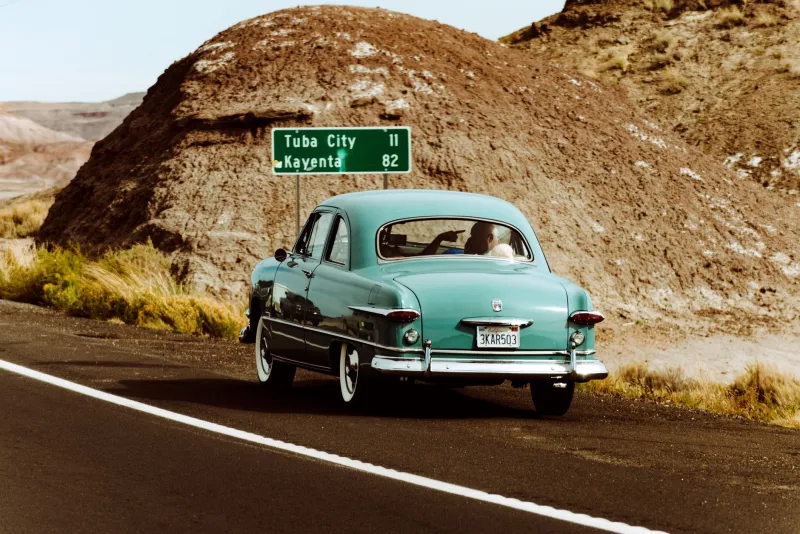
The passenger seat, it turns out, has always been one of Hollywood's most productive offices.