Fingers on the Film: The Vanishing Craft of Editing Celluloid by Hand
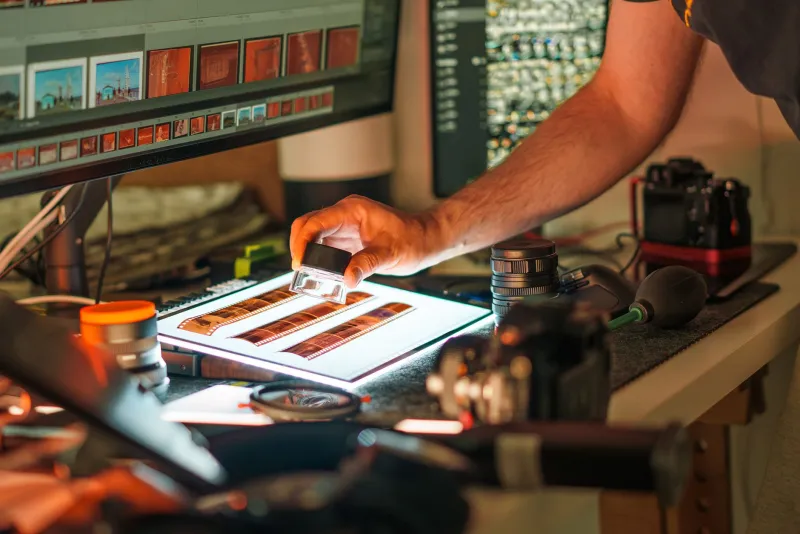
There's a smell that veterans of the old cutting rooms still talk about. Warm celluloid, a faint chemical tang, the dusty wood of the editing bench. It wasn't glamorous. It wasn't even particularly comfortable. But for the editors who spent decades in those rooms — hunched over Moviolas, running strips of film through their fingers, making cuts they could never undo — it was as close to sacred as the movie business got.
Before Avid. Before Final Cut. Before the cursor and the timeline and the infinite undo button, film editing was a craft you felt in your hands.
The Room Where Stories Were Built
The classic Hollywood cutting room was a specific kind of controlled chaos. Strips of film hung from numbered pins on long cloth-covered racks called trim bins, dangling like laundry in a strange, flickering archive. Every strip represented a take, a decision, a possibility. The editor's job was to find the story buried inside all of it.
Tools were minimal and unforgiving. A splicer — essentially a precision guillotine — cut the film at an exact frame. Tape or cement joined the pieces. A grease pencil marked the frame. And then you ran it through the Moviola, a motorized viewer about the size of a small refrigerator, and you watched what you'd built.
If you made the wrong cut, you didn't hit Control-Z. You carefully peeled the splice apart, hoped you hadn't scratched the emulsion, and tried again. Every decision carried weight because every decision had a physical cost.
Veteran editor Carol Littleton, who cut E.T. the Extra-Terrestrial and Body Heat, once described the experience as "thinking with your hands." That phrase has stuck around the industry for good reason. The tactile engagement of physical editing wasn't incidental — it was part of how editors processed the material. Feeling the film move through your fingers, holding a strip up to the light to read the frame — these weren't just technical steps. They were how you got to know the footage.
The Irreversibility Factor
Here's something that gets lost in modern conversations about editing: the old way demanded a kind of commitment that digital workflows simply don't require. When you made a cut on celluloid, you were making a statement. The film was shorter. That frame was gone from the sequence, physically removed and dropped into the trim bin.
Some editors argue that irreversibility sharpened instincts. You didn't second-guess yourself into paralysis because second-guessing had real consequences. You trusted your gut, you made the cut, and you moved forward. There was an economy of decision-making baked into the physical medium itself.
That doesn't mean editors weren't meticulous — they absolutely were. But the meticulous work happened in the preparation, in the careful viewing, in the deliberate marking of frames before the splicer ever came down. The process forced a kind of pre-visualization that digital editing, with its infinite flexibility, doesn't always demand.
Dede Allen, the legendary editor behind Bonnie and Clyde and Dog Day Afternoon, was known for her rhythmically aggressive cutting style — jarring, propulsive, emotionally raw. That style wasn't just an aesthetic preference. It was partly born from the physical act of cutting, from the feel of where the film wanted to break. Rhythm, in the old cutting rooms, was something you heard and felt before you ever saw it on screen.
What the Moviola Taught You
The Moviola is worth dwelling on for a moment, because it shaped how an entire generation of editors understood time and motion. Unlike modern software, which gives you a broad visual overview of your entire cut, the Moviola showed you a small, flickering image — one moment at a time. You were inside the film, not above it.
That intimacy changed the way editors engaged with performance. You weren't looking at waveforms or clip thumbnails. You were watching an actor's face, frame by frame, searching for the exact moment a thought crossed their eyes. Editors developed an almost preternatural sensitivity to micro-expressions, to the tiny physical tells that make a performance feel true.
Walter Murch, who edited Apocalypse Now and The English Patient and later wrote brilliantly about the craft in In the Blink of an Eye, has talked extensively about the blink — the idea that a cut feels natural when it coincides with the moment a character (or the audience) would instinctively blink. That kind of observation comes from years of staring at film one frame at a time, developing a near-biological understanding of how human attention moves.
The Bridge Generation
The editors who matter most to this story are the ones who crossed the divide — who learned their craft on film and then had to relearn it on Avid in the 1990s. They're the bridge generation, and talking to them now is like talking to someone who learned to navigate by stars and then had to explain GPS to themselves.
Many of them describe the transition with a mix of relief and grief. Relief because the physical labor was genuinely exhausting — the lifting, the organizing, the constant management of physical media. Grief because something about the intimacy of the old process didn't fully survive the move to screens.
"You used to know where everything was," one veteran editor said, describing the trim bins. "You could reach into that bin and pull out a specific look from take four because you remembered exactly how it felt in your hand." The spatial memory of physical editing — knowing your footage by its physical location in the room — dissolved when everything became a file.
What replaced it was power. Enormous, almost uncomfortable power. The ability to try anything, instantly, without consequence. For some editors, that freedom was liberating. For others, it introduced a kind of creative vertigo that took years to manage.
What the Hands Knew
There's a broader conversation in cinema culture right now about the relationship between craft and technology — about whether the frictionless tools of modern filmmaking have made movies better or just faster. Editing sits at the center of that debate in a particularly interesting way, because editing is where story actually gets made.
The old editors weren't more talented than today's editors. But they were differently trained, in ways that left distinct marks on the work. The rhythms of classic Hollywood editing, the instinctive pacing of a Dede Allen or an Anne Bauchens, carry the fingerprints of the physical medium. You can feel the weight of the cut.
That's not nostalgia talking. It's craft history. Understanding where the discipline came from — the smell of the cutting room, the grease pencil marks, the irreversible click of the splicer — is part of understanding why cinema moves us the way it does.
The stories didn't just get told in those rooms. They got built, strip by strip, frame by frame, by people who understood that time itself was something you could hold in your hands.