Popcorn, Folding Chairs, and Pure Cinema: How Small-Town Film Societies Are Keeping the Art Alive
Somewhere in central Ohio, about forty miles from the nearest AMC, a group of roughly thirty people is settling into metal folding chairs arranged in a Presbyterian church fellowship hall. Someone dims the fluorescent overheads. A portable projector flickers to life. On a pull-down screen that's seen better days, Federico Fellini's 8½ begins to unspool.
This is not a film class. Nobody is getting credit. There's no algorithm that recommended this evening. A retired schoolteacher named Donna organized it, printed the programs herself, and brought homemade snacks in a canvas tote bag.
This is a film society. And scenes like this one are playing out in hundreds of towns across America that the multiplex industry long ago decided weren't worth the investment.
The Spaces Between the Cineplexes
When the big chains pulled out of smaller markets — and they pulled out hard, especially after the pandemic reshuffled the economics of theatrical exhibition — they left behind something nobody fully accounted for: a genuine cultural hunger. People in towns of five thousand, ten thousand, even twenty thousand still want to watch movies together. They just don't always have anywhere to do it.
Film societies filled that gap, often without fanfare or funding. They operate out of library meeting rooms, repurposed storefronts, community centers, and yes, church basements. Their budgets are thin. Their technical setups range from surprisingly sophisticated to genuinely improvised. But their programming? Often more daring than anything playing at the nearest sixteen-screen complex.
Take the Millbrook Cinema Collective in upstate New York, which has been running monthly screenings for over a decade out of a converted grain warehouse. In the past year alone, they've shown silent-era Buster Keaton with live piano accompaniment, a retrospective of Agnès Varda's early work, and a double feature pairing Chinatown with a locally made documentary about water rights. That's a programming slate that would make an art house curator in Brooklyn genuinely envious.
The People Who Make It Happen
The volunteers behind these organizations are a particular breed of passionate. They're not doing it for money — there isn't any. They're doing it because they believe, sometimes almost stubbornly, that watching a great film in a room full of other people is a fundamentally different experience than watching it alone on a laptop.
"There's a moment," says Marcus, who runs a film society in a small Kansas town and asked that his last name not be used, "where you can feel the room react together. Someone laughs, and then someone else laughs because they heard the first laugh. Or a scene hits hard and you can feel everyone go quiet at the same time. You can't get that from your couch."
Marcus started his group after the town's only theater closed in 2019. He'd never run any kind of organization before. He figured out licensing through trial and error — a learning curve that trips up a lot of well-meaning would-be organizers, since screening films publicly requires proper licensing even for nonprofits. He now works with services like Swank Motion Pictures and Criterion's institutional licensing arm to keep everything above board.
Curation is another skill these organizers develop on the fly. Without a studio marketing department telling them what to show, they have to actually think about programming — building themes, responding to what their audiences respond to, taking swings on films that might challenge or provoke.
What the Algorithm Can't Do
Here's the thing about Netflix, Hulu, and the rest of the streaming universe: they're extraordinary at giving you more of what you already like. The recommendation engine is genuinely impressive technology. But it's not curation. It's pattern matching.
A human film programmer — even an amateur one working out of a church basement — brings something different. Intention. Point of view. The willingness to say, "I think you should see this, even if you don't think you want to."
That's what film societies have always offered, going back to their origins in mid-twentieth century America, when cinephiles in cities started organizing around foreign films and independent work that mainstream theaters wouldn't touch. The tradition never fully died. It just migrated, quietly, to smaller towns where the need turned out to be just as real.
And the conversations that happen after the credits roll — those can't be replicated digitally either. Post-screening discussions at these gatherings tend to be genuinely lively, sometimes contentious, always engaged. People who might never otherwise talk to each other find themselves arguing about camera angles and moral ambiguity in a church fellowship hall at nine-thirty on a Tuesday night. That's not nothing. That's actually kind of extraordinary.
Challenges That Don't Quit
None of this is easy, and it would be dishonest to romanticize the difficulties away. Funding is a perpetual scramble — most groups survive on small membership fees, the occasional grant from a local arts council, and a lot of in-kind generosity. Equipment breaks. Volunteers burn out. Attendance fluctuates in ways that are hard to predict and harder to control.
Licensing costs can be a genuine barrier, especially for groups trying to show newer releases. And finding films in formats that work with affordable projection setups is its own ongoing puzzle.
There's also the challenge of audience development — reaching people who might love what these groups are doing but don't know they exist. Social media helps, but it's uneven. Word of mouth remains the most reliable engine, which means growth tends to be slow and organic.
Some groups have found creative workarounds. Partnering with local libraries gives them built-in audiences and often free space. Collaborating with high school film teachers brings in younger viewers. Theming screenings around local history or current events gives people a hook beyond "here's a great movie."
Why It Matters More Than Ever
In an era when the theatrical experience is under genuine existential pressure — when studios are debating whether to shorten or eliminate theatrical windows, when streaming is reshaping how people relate to movies at a fundamental level — these small-town film societies are doing something quietly radical.
They're insisting that cinema is a communal art form. That watching a movie is not just content consumption. That the shared experience of sitting in a dark room with your neighbors and surrendering to a story together has value that can't be quantified in engagement metrics.
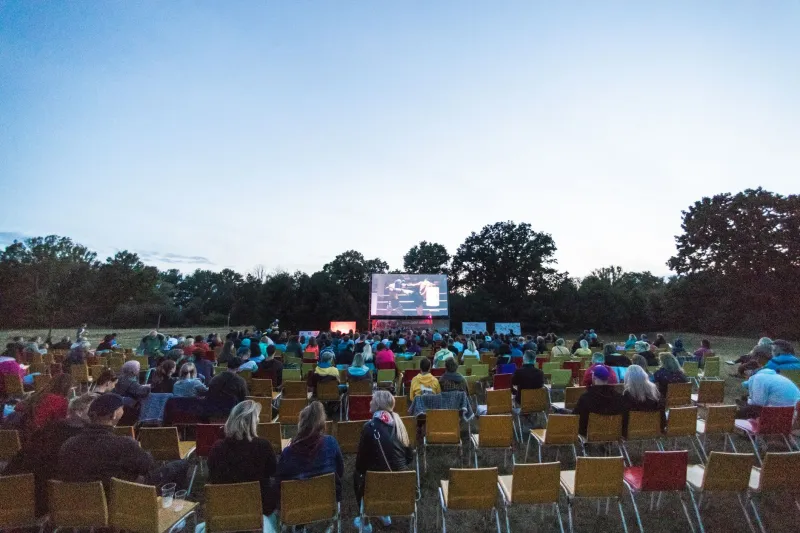
And they're proving that you don't need a massive budget or a prime real estate location to create that experience. You need a screen, some chairs, a decent projector, and people who care enough to show up.
Donna, back in that Ohio church hall, wraps up the post-screening discussion of 8½ around ten-fifteen. People linger. Someone argues that Guido is irredeemably self-absorbed. Someone else says that's the whole point. Donna starts folding up chairs.
Next month, she's thinking about showing Shoplifters. She already knows half the room will love it and half will need convincing. She's looking forward to the argument.
That's the picture palace that matters now. It doesn't look like what you'd expect. But it's very much alive.