Before the Credits Roll: The Designers Turning Theater Lobbies Into Reasons to Show Up Early
For most of American moviegoing history, the lobby was a problem to solve. Get the popcorn. Find the bathroom. Don't miss the previews. The space between the street and the seat was purely transactional—a corridor dressed up with movie posters and the smell of artificial butter.
A small but growing movement in theater design is challenging that assumption from the ground up. And the results, in the handful of venues where it's really been tried, are quietly redefining what it means to go to the movies.
Why the Lobby Fell Behind
To understand why theater lobbies became such afterthoughts, you have to understand the economics that shaped them. The multiplex boom of the 1980s and 90s prioritized throughput above everything else. More screens meant more showtimes, more showtimes meant more bodies moving through the building, and more bodies moving through the building meant the lobby had to function like a very efficient machine for separating people from their money and depositing them in seats.
Design followed function. Lobbies got bigger, brighter, and louder. The concession stand expanded to fill whatever space was available. The aesthetic, if you could call it that, was essentially airport terminal—high ceilings, hard surfaces, and the particular kind of corporate cheerfulness that communicates nothing except scale.
What got lost in that process was atmosphere. The sense that arriving at a movie theater was itself part of the experience—that the building had something to say about the kind of evening you were about to have.
The New Lobby Thinking
The designers who are working to change this come from a variety of backgrounds—architecture, hospitality, retail design, even museum curation—and they're applying a fundamentally different logic to the problem. Instead of asking how to move people through a lobby efficiently, they're asking how to make people want to stay.
"The lobby is the first act," says one theater designer who's worked on renovations for independent venues across the Midwest and Pacific Northwest. "It sets the emotional key for everything that follows. If you walk into a space that feels generic and indifferent, you're starting the experience in a kind of neutral flatness. That's not the best condition for opening yourself up to a film."
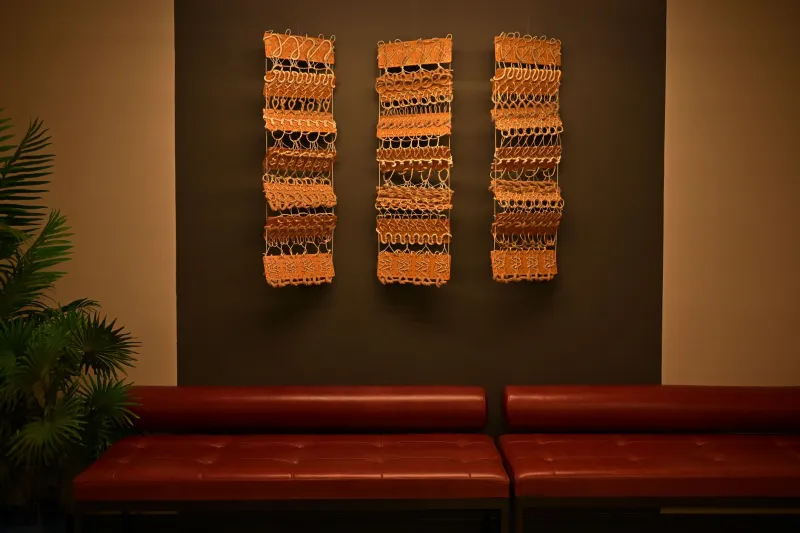
The alternative she and her colleagues are developing looks quite different. Lower lighting levels that create intimacy rather than the fluorescent brightness of a convenience store. Materials with texture and warmth—wood, stone, fabric—that signal care and craft. Spatial arrangements that encourage people to slow down, find a corner, have a conversation.
Some of the most interesting work is happening around what these designers call "threshold moments"—the specific points in the lobby experience where the outside world starts to recede and the cinematic world begins to take hold. A well-designed lobby can begin that psychological transition before anyone has even found their seat.
Art, Community, and the Case Against the Megaplex
Several independent theaters that have invested in lobby redesigns have gone further, treating the space as something closer to a community gallery. Rotating art installations tied to current programming. Local photography on the walls. Reading nooks stocked with film-related books and periodicals. In a few cases, small performance spaces that host events on nights when the screens are dark.
The Alamo Drafthouse chain, which has long positioned itself as a cinema culture destination rather than just a movie venue, has been influential here. But some of the most compelling experiments are happening at smaller, single-screen or two-screen independents that have recognized they can't compete with streaming on convenience—so they're competing on experience instead.
One theater in Portland, Oregon, redesigned its lobby around a central bar and lounge area, with local artwork cycling through every six weeks in partnership with a neighborhood gallery. The result was a space that people started visiting even when they weren't seeing a film—stopping in for a drink, checking out the art, picking up a schedule. The lobby became a community anchor in a way that no multiplex has ever managed to be.
"We stopped thinking about ourselves as a movie theater and started thinking about ourselves as a cultural venue that shows movies," the owner explained. "The lobby is where that identity lives."
The Design Details That Actually Matter
For all the philosophical framing, the designers working in this space are also deeply practical about what actually moves the needle for audiences. A few principles come up repeatedly in conversations with the people doing this work.
Lighting is almost universally cited as the highest-leverage change a theater can make. Moving away from overhead fluorescents toward warmer, more directional light sources transforms the emotional register of a space almost immediately. It's also relatively affordable compared to structural renovations, which makes it an attractive starting point for venues with limited budgets.
Acoustics matter more than most people realize. The hard, reflective surfaces of a typical multiplex lobby create a din that raises stress levels and makes conversation difficult. Introducing sound-absorbing materials—textiles, acoustic panels, vegetation—brings the noise floor down and makes the space feel more human in scale.
And then there's smell, which is the most primal and least discussed element of environment design. The artificial butter smell that defines most American multiplex lobbies is a powerful brand signal, but it's also a kind of sensory monoculture. Theaters that have experimented with actual food programs—real coffee, fresh-baked goods, locally sourced snacks—report that the change in atmosphere is immediate and significant.
Competing With the Couch
The existential pressure on movie theaters in the streaming era is real, and no amount of good lobby design is going to make up for a weak film program or a deteriorating screen experience. But the designers working in this space make a compelling argument that the physical, social, atmospheric experience of moviegoing is something streaming genuinely cannot replicate—and that theaters have been leaving that advantage on the table by treating their non-screen spaces as afterthoughts.
When someone chooses to leave their house, drive to a theater, and pay for a ticket, they're already expressing a preference for experience over convenience. The question is whether the theater meets them there—whether the building itself signals that the evening is going to be worth it.
The best lobby redesigns answer that question before a single frame of film has rolled. They say: you made the right call. Something real is about to happen here.
That's not a small thing. In a world where staying home has never been easier, it might be exactly the thing that saves the movies.